%20(1).png)
Breathing and Asymmetry: A Postural Restoration® Approach to Airway Health

Updated: 3 days ago

Airway health is not only about the nose, tongue, palate, or airway space.
It is also about how the body organizes itself in space.
When a patient struggles with breathing, tongue posture, oral dysfunction, craniofacial imbalance, neck tension, jaw pain, sleep-disordered breathing, or postural compensation, the issue may not be isolated to the mouth or airway alone. The body may be responding to deeper asymmetries involving the pelvis, rib cage, diaphragm, cervical spine, vision, dental occlusion, feet, and nervous system.
In an Airway Circle Thursday Night Live presentation, Aleena Kanner, a Postural Restoration® provider and certified athletic trainer, shared a powerful perspective on breathing and asymmetry through a Postural Restoration® lens.
Her message was clear: we are inherently asymmetrical, and when the body cannot manage that asymmetry well, dysfunction may show up in posture, breathing, pain, dental occlusion, tongue function, airway patterns, and nervous system regulation.
For myofunctional therapists, dentists, orthodontists, ENTs, speech-language pathologists, physical therapists, chiropractors, bodyworkers, optometrists, and airway-focused providers, this conversation reinforces one essential truth:
The airway does not function separately from the body.
What Is Postural Restoration®?
Postural Restoration®, often referred to as PRI, is not simply posture correction.
It is not about telling patients to stand taller, pull their shoulders back, or do chin tucks.
Aleena explained that PRI looks at how the sensory system, nervous system, respiratory system, muscular system, visual system, dental occlusion, rib cage, pelvis, diaphragm, feet, and cervical spine interact to position the body in space.
In other words, PRI is not just about what posture looks like externally. It is about why the body is choosing that position.
This is especially relevant in airway health because breathing is deeply connected to posture, rib cage mechanics, tongue position, jaw function, vision, and nervous system regulation.
Why Human Asymmetry Matters

Human beings are not symmetrical.
We have a liver on the right side of the body, three lung lobes on the right and two on the left, a heart that sits more to the left, asymmetrical diaphragmatic attachments, asymmetrical brain function, visual differences, and dominant neuromotor patterns.
Aleena explained that these asymmetries are normal. They are part of being human.
The problem is not that we are asymmetrical.
The problem is when the body becomes stuck in one pattern and cannot shift, alternate, breathe, and organize efficiently from side to side.
A healthy body should be able to move between right and left. It should be able to rotate, alternate, sense the ground, breathe into both sides of the rib cage, and organize the head, neck, jaw, and airway over the body.
When that does not happen, patients may develop compensatory patterns.
External Asymmetry as a Clinical Clue
External asymmetry can be a sign that the body is not managing internal asymmetry well.
Clinicians may notice:
One shoulder lower than the other
One eye higher than the other
Jaw deviation
Ear flare
Rib flare
Pelvic rotation
Foot pronation or supination
Forward head posture
Neck tension
Uneven facial posture
Asymmetrical smile or bite
Tongue deviation
Body leaning to one side
These findings are not random. They may reflect how the body is organizing around internal pressures, sensory input, airway needs, visual orientation, dental occlusion, and breathing mechanics.
For airway providers, this is important because the mouth may be revealing a whole-body pattern.
Breathing Is the Starting Point, But Not Always the Whole Answer
Aleena emphasized that breathing is often where she begins treatment.
However, breathing alone is not always enough.
A patient may need to learn how to breathe better, but if there is a major dental occlusion issue, visual issue, foot sensory issue, or cranial pattern that keeps the body stuck, breathing exercises alone may not fully resolve the problem.
This is an important clinical distinction.
Breathing is foundational, but it does not exist in isolation.
For some patients, the care plan may also need to include:
Dental collaboration
Vision evaluation
Footwear or foot support
Postural Restoration® techniques
Myofunctional therapy
Orthodontic evaluation
Cervical spine assessment
Rib cage and diaphragm work
Nervous system regulation
Cranial or body-based therapy
The goal is not to chase symptoms. The goal is to understand the system.
Why Belly Breathing May Not Be Ideal
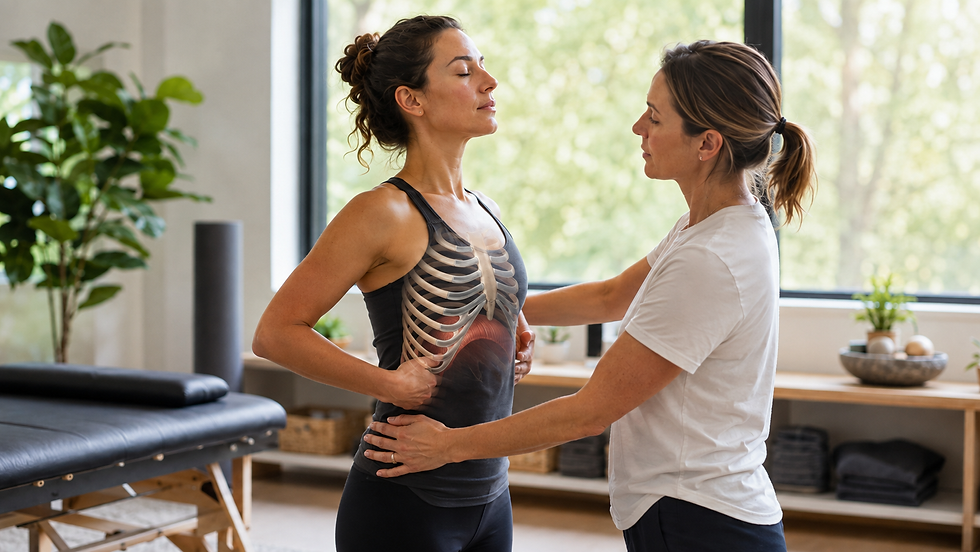
One of the most important clinical points from Aleena’s presentation was her discussion of belly breathing.
Many patients are taught to place one hand on the chest and one hand on the belly, then breathe so that only the belly moves. Aleena strongly cautioned against this approach.
From a PRI perspective, optimal breathing is not simply pushing the abdomen forward.
When a patient breathes only into the belly, they may lose rib cage expansion, remain extended through the back, and fail to achieve proper diaphragm doming on exhalation.
Instead, functional breathing should involve coordinated movement of the rib cage, diaphragm, abdomen, and chest.
The lungs live in the chest. The rib cage needs to expand. The diaphragm needs to move through a full range of motion. The body needs to be able to exhale fully, allow the ribs to come down, and then inhale into a rib cage that can expand.
The problem is not chest expansion.
The problem is accessory breathing, where the neck and upper chest muscles pull the rib cage upward because the diaphragm and rib cage are not working efficiently.
The Importance of the Exhale
Aleena emphasized that full exhalation is essential.
During exhalation, the ribs should come down and the diaphragm should dome upward. This helps create a better starting position for the next inhale.
If a patient cannot exhale fully, the rib cage may remain flared or extended, and the diaphragm may remain flattened.
This can contribute to:
Forward head posture
Rib flare
Neck tension
Upper back tightness
Accessory breathing
Poor diaphragm mechanics
Poor rib cage mobility
Difficulty regulating the nervous system
Persistent postural compensation
For myofunctional therapists and airway providers, this matters because breathing exercises should not only focus on nasal breathing or slow breathing. They should also consider rib cage position, exhalation, diaphragm mechanics, and whole-body organization.
Posterior Mediastinum Expansion: Air Into the Upper Back
Aleena discussed the importance of posterior mediastinum expansion.
The posterior mediastinum refers to the area in the upper back where many patients feel tightness, pressure, or the need to foam roll, crack, or stretch.
From a PRI perspective, that sensation may be a call for airflow.
If the upper back and posterior rib cage are compressed, the patient may struggle to expand into that space. Instead, they may compensate by lifting the chest, overusing the neck, or pushing the belly forward.
Helping patients access airflow into the posterior rib cage can support:
Better rib cage mechanics
Improved diaphragm function
Reduced neck tension
Improved nervous system regulation
Better postural organization
Improved breathing efficiency
Reduced extension patterns
This is highly relevant for patients who are chronically stressed, extended, braced, or unable to relax at night.
Breathing, the Vagus Nerve, and Nervous System Regulation
Aleena also highlighted the connection between breathing and nervous system regulation.
The vagus nerve passes through the thoracic region, and breathing mechanics can influence the body’s ability to regulate, calm down, and shift out of a heightened stress state.
Patients who feel constantly “on,” tense, anxious, wired, or unable to settle may benefit from learning how to access better rib cage expansion and more complete exhalation.
This reinforces something airway professionals see every day: breathing is not only mechanical.
Breathing is neurological.
The Cervical Spine and Cranial Asymmetry
Aleena explained that cranial asymmetries often influence cervical spine asymmetries.
The cervical spine helps orient the head over the body. If the head is not well centered, the neck may compensate. If the neck cannot move freely, the jaw, tongue, airway, eyes, and bite may also be affected.
She discussed how cervical testing can reveal whether the head and neck are organizing over one side of the body more than the other.
This matters because forward head posture, limited neck rotation, jaw deviation, and tongue posture may all be part of a broader pattern rather than isolated problems.
The Role of Cranial Bones
Aleena discussed cranial bones including the temporal bones, maxilla, mandible, and sphenoid.
From a PRI and cranial perspective, these structures influence jaw position, eye position, facial asymmetry, bite, and cervical mechanics.
For example:
Temporal bone position may influence mandibular position
Sphenoid position may relate to eye height and visual orientation
Maxillary structure may affect the palate, nasal floor, and dental occlusion
Mandibular deviation may reflect cranial and body patterning
This is especially important for airway-focused providers because the palate, jaw, tongue, nasal floor, and cranium are interconnected.
Dental Occlusion as a Sensory System
One of the most clinically relevant sections of Aleena’s presentation was her discussion of dental occlusion.
The teeth are not only for chewing. They also provide sensory information to the brain.
The periodontal ligaments around the teeth help the nervous system understand pressure, position, contact, and orientation.
If the bite is uneven, missing contacts, heavy on one side, or affected by extractions, orthodontics, retainers, or appliances, the brain receives different sensory input.
This can influence:
Jaw tension
Neck position
Postural organization
Clenching
Sleep quality
Back pain
Head position
Nervous system regulation
Body awareness
For dentists, orthodontists, and myofunctional therapists, this reinforces the importance of looking at occlusion as part of a whole-body system.
Sensory Splints and Neurological Input
Aleena discussed the use of flat-plane mandibular sensory splints in selected patients.
These splints are not simply mouthguards. They are designed to provide sensory input and help the brain feel more even contact through the bite.
She described them as a type of “eraser” for the nervous system, helping patients feel a different kind of input at night so the body can calm down and reorganize.
These appliances are not necessarily for every patient, and timing matters. Aleena emphasized that they are typically not a first-visit intervention. They should be considered within a broader clinical process and ideally in collaboration with trained dental and postural providers.
Vision and Postural Restoration®
Vision is another major part of the PRI model.
Aleena explained that the visual system helps the brain understand where the body is in space. It is not only about seeing clearly. It is about how both eyes work together to orient the body.
In some cases, vision changes may influence posture, neck position, bite sensation, and body organization.
This is why PRI providers may collaborate with optometrists, especially those who understand postural and binocular vision relationships.
For complex airway patients, this may be relevant when symptoms persist despite myofunctional therapy, orthodontics, expansion, bodywork, or dental care.
Feet, Grounding, and Whole-Body Organization
Aleena emphasized that she would not treat neck pain without looking at what the patient is wearing on their feet.
The feet provide essential sensory information to the nervous system. If the body cannot sense the ground well, it may struggle to organize the pelvis, rib cage, neck, jaw, and head.
This can affect breathing and airway function indirectly through posture and nervous system control.
For airway professionals, this may feel outside the mouth, but it is not outside the patient.
A patient’s tongue posture may be influenced by what the body below the tongue is doing.
Why Chin Tucks Are Not Always the Answer
Forward head posture is commonly addressed with chin tucks, but Aleena cautioned that this may not be ideal when the rest of the body is not addressed.
If the rib cage is flared, the body is extended, the neck curve is altered, or the patient cannot access proper rib cage expansion, simply pulling the head back may not solve the problem.
In some cases, chin tucks may reinforce tension rather than restore function.
This is an important reminder: posture correction should not be forced from the outside. It should emerge from better internal organization, breathing mechanics, sensory input, and body awareness.
Postural Restoration® and Myofunctional Therapy
Myofunctional therapy and Postural Restoration® can complement each other beautifully.
Myofunctional therapy focuses on nasal breathing, tongue posture, lip seal, swallowing, chewing, oral rest posture, and functional oral patterns.
Postural Restoration® can help address the body’s ability to manage asymmetry, breathe into the rib cage, sense the ground, organize the pelvis, center the neck, and regulate through sensory input.
Together, these approaches may be helpful for patients with:
Mouth breathing
Low tongue posture
Jaw deviation
Tongue deviation
Forward head posture
Neck tension
Bruxism
TMJ symptoms
Orthodontic relapse
Palatal expansion challenges
Poor sleep
Chronic pain
Postural asymmetry
Pelvic floor dysfunction
Visual or dental sensory issues
When the body becomes more centered, the mouth may function better. When the mouth functions better, the body may regulate better.
Orthodontics, Expansion, and Timing
Aleena discussed that patients undergoing orthodontics or palatal expansion may benefit from body-based support.
Orthodontic treatment and expansion change cranial and dental structures. In some patients, this may influence vision, posture, bite sensation, cranial strain, and nervous system response.
She explained that some patients may benefit from Postural Restoration® techniques before, during, or after expansion, especially if they have significant asymmetry, pain, visual changes, or difficulty adapting.
This does not mean every expansion patient needs PRI. It means complex patients may need more interdisciplinary support.
The sequence matters.
For some patients, the body may need to become more neutral and regulated before major dental or orthodontic changes.
Clinical Questions for Healthcare Professionals
When evaluating patients with airway, myofunctional, dental, or postural concerns, healthcare professionals may consider asking:
Is the patient externally asymmetrical?
Does the patient have one shoulder lower than the other?
Is there jaw deviation or tongue deviation?
Does the patient have a rib flare?
Can the patient exhale fully?
Is the patient belly breathing instead of expanding the rib cage?
Does the patient feel constant upper back tightness?
Does the patient clench more on one side?
Is the bite uneven or missing sensory contact?
Has the patient had orthodontics, extractions, retainers, expansion, or dental appliances?
Does the patient have visual issues or recent vision changes?
Can the patient sense the ground well through the feet?
Is the neck centered over the body?
Is the patient stuck in one pattern?
Could the patient benefit from collaboration with a PRI provider, dentist, optometrist, podiatrist, or myofunctional therapist?
These questions help move care from isolated treatment to whole-system evaluation.
Key Takeaways for Healthcare Professionals
Postural Restoration® is not typical posture correction. It evaluates the sensory, respiratory, visual, dental, muscular, and nervous systems together.
Human asymmetry is normal, but being stuck in one pattern can contribute to dysfunction.
Breathing is foundational, but breathing exercises alone may not solve problems driven by dental, visual, foot, or cranial sensory issues.
Belly breathing may reinforce extension and poor rib cage mechanics when taught incorrectly.
Functional breathing should include rib cage expansion, full exhalation, diaphragm doming, and posterior mediastinum expansion.
Dental occlusion provides sensory input to the nervous system and may affect posture, pain, and regulation.
Vision and feet play major roles in how the body understands space.
Chin tucks and forced posture correction may not address the root problem.
Myofunctional therapy and Postural Restoration® can work together to support airway, tongue, posture, and whole-body function.
Interdisciplinary care is essential for complex patients.
The Airway Circle Perspective

At Airway Circle, we believe airway health must be understood through a whole-body lens.
Aleena Kanner’s presentation reminds us that the airway is not floating above the body. The tongue, palate, jaw, neck, rib cage, pelvis, feet, eyes, and nervous system are all connected.
For healthcare professionals, this means we must be willing to look beyond our own discipline.
The myofunctional therapist needs the body-based provider.
The dentist needs the postural and visual lens.
The orthodontist needs to consider the patient’s ability to adapt.
The optometrist, podiatrist, physical therapist, ENT, and airway team all have a role.
Complex patients need complex collaboration.
Final Thoughts
Breathing and asymmetry are deeply connected.
When the body cannot manage its natural asymmetries, it may compensate through posture, breathing, jaw position, tongue function, vision, foot pressure, rib cage mechanics, and nervous system tension.
For airway-focused providers, this changes the way we see patients.
A tongue problem may also be a rib cage problem.
A jaw deviation may also be a cranial and pelvic organization problem.
A breathing pattern may also be a nervous system and sensory problem.
A posture issue may also be an airway issue.
The future of airway care is interdisciplinary, sensory-informed, function-focused, and whole-body aware.
Need Guidance With Airway, Breathing, or Myofunctional Therapy?
Finding the right support for airway health, breathing, sleep, tongue function, posture, oral restrictions, or whole-body compensation patterns does not have to feel overwhelming. With the right guidance, patients and providers can better understand the clinical picture and explore the next best steps.
Whether care involves myofunctional therapy, airway-focused dentistry, orthodontics, ENT evaluation, sleep testing, Postural Restoration®, physical therapy, vision support, dental collaboration, or referrals to the right provider, the goal is to improve function and quality of life.
Your journey to better breathing, better sleep, and better oral function starts here.


Comments